
Feeding Your Own Soul

This post is part of Blogchatter’s A2Z Challenge 2026: F is for Feeding Your Own Soul. There is a saying I have carried from my mom. The main ingredient in any dish is a sprinkling of love. Not a technique, not a recipe, not an expensive pantry. Just love, unhurried, wholehearted, and completely present. Without it, even the most carefully assembled dish falls flat. Feeding Your Own Soul has never been, for me, a chore or a routine. It has always been a calling.
A Passion That Found Its Voice
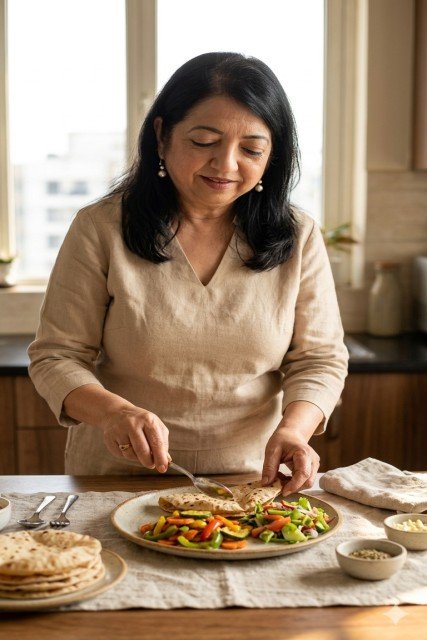
Fifteen years ago, a quiet corner of the internet became my kitchen table. I began a food blog, and within it, a series called Recipes for Singles, born from the understanding that cooking for one deserves the same care and artistry as cooking for many. What followed surprised even me. Two Kindle recipe books, Sugar & Ice & All That’s Nice: A Collection of Virgin Cocktails & Decadent Desserts and EASY INDIAN FUSION COOKING: A Melange of Nutritious Breakfast & Easy Chicken Dinner Recipes, found their way into readers’ hands. Their warmth in writing back still moves me. Cooking competitions, both online and offline, sharpened my instincts and rewarded my passion with recognition I had never sought but deeply valued.
Yet the truest reward was never a trophy or a download count. It was the moment someone attempted a recipe and felt something shift in their kitchen. That is what food does when it is crafted with complete devotion. It reaches people in spaces that words alone cannot enter.
The Boy on the Kitchen Counter
My son arrived in my kitchen before he could articulate why he was drawn there. As a child, he would perch on the kitchen counter, legs dangling, eyes wide, watching every movement with an intensity that was both endearing and quietly serious. In fact, he did not merely observe. He absorbed everything: flavours, techniques, and the unhurried confidence of a woman who cooked as naturally as she breathed.
In time, he stepped down from that counter and into the kitchen himself. What emerged from his hands was nothing short of extraordinary. He created bold, inventive dishes that carried his own distinct signature while honouring everything he had learnt at my elbow. He became a master chef in his own right, and I watched with a pride so deep it had no adequate expression.
When I entered the MasterChef India competition, he was with me in every sense that mattered. It felt like the most fitting tribute, taking our shared love of food into the world’s most watched kitchen.
The Moment I Chose Dignity Over Drama
I made it to the third round. And then I walked away.
However, the production team had a narrative in mind. They wanted tears on camera. They wanted the image of a bereaved widow, a mother hollowed by grief, a woman undone by loss. That was the story that would serve their TRP numbers, and they pursued it without apology.
So my response was clear. I would speak about my life, but only as testament to resilience, as living proof that one can emerge from devastation without being defined by it. If my story was to reach millions of viewers across India, it would reach them as hope, not as spectacle. They were not interested in that version of me. Therefore, I gathered myself and left.
Not once have I questioned that decision. My grief was never available for public consumption. My strength, however, has always been.
When the Kitchen Lost Its Music
Then the unimaginable arrived. My son passed away, and something within me broke in a way that had no visible edges.
Meanwhile, the kitchen continued to function. I prepared meals, nourished my daughter, and let the rhythms of daily life insist on continuing. However, the creative fire that had fuelled decades of experimentation simply went out. For two long years, I photographed no dish, wrote no post, shared no story. The blog fell silent. The kitchen, though occupied, had lost its music entirely.
Grief rarely arrives as we imagine it will. Sometimes it does not come as tears or collapse. Instead, it arrives as the quiet disappearance of everything that once brought you joy without effort. That absence can be the most disorienting loss of all.
The Slow, Gentle Return
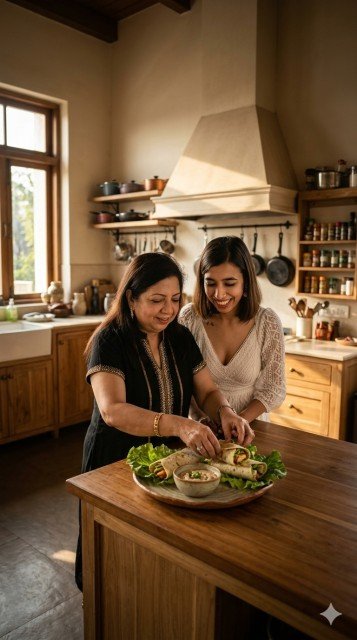
My daughter coaxed me back, not with grand gestures, but with the persistent, affectionate creativity of someone who understood exactly what she was doing. She would arrive with an unfamiliar ingredient, suggest an unexpected pairing, or simply challenge me with a raised eyebrow and a question: ” Can you make something with this? Slowly, tentatively, the kitchen began to feel like mine again.
Today, I cook with the same devotion I always have. When guests grace our home, every dish receives my full presence. During festivals, I prepare food and carry it to my neighbours, because abundance was always meant to be shared beyond the table it originated from. Above all, the love woven into every meal remains unchanged. That has survived everything.
Eating With the Seasons, Eating With the Soul
Feeding your own soul also means learning to receive nourishment as generously as you offer it. For me, that wisdom arrived through simplicity and through a return to the foods that have always felt like home.
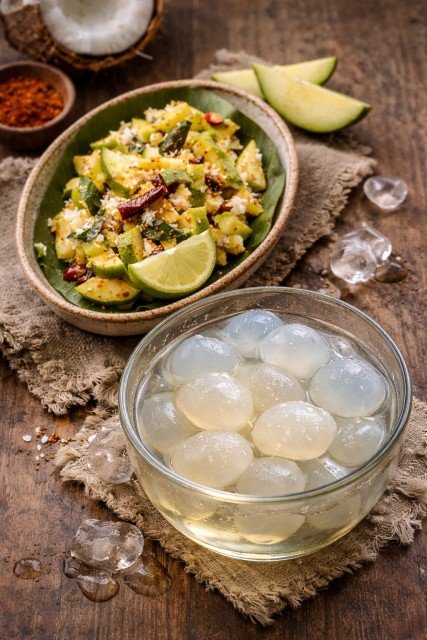
Summer arrives in Hyderabad and so does the Kobbari Maamidikaya, that extraordinary green mango found only in Andhra and Telangana, raw and tangy and entirely irreplaceable. A couple of months, and then it is gone. I savour every serving as though it might be the last of the season, because it very well might be. Close behind come the Taati Munjalu, palm fruits, translucent, cool, and impossibly refreshing against the summer heat. These are not delicacies one finds in a supermarket. They belong to a specific geography, a specific season, and a specific memory. They taste, above all, like belonging.
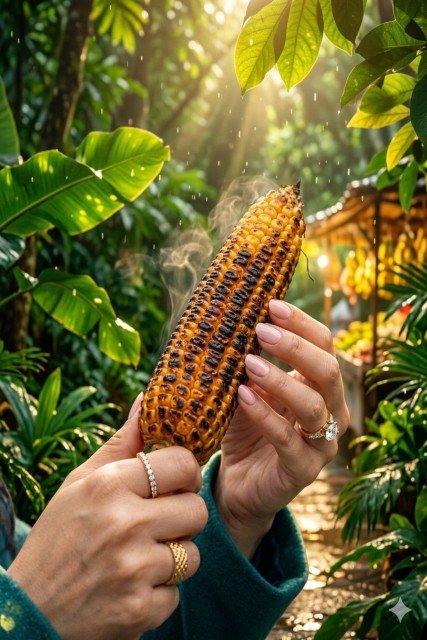
When the monsoon arrives with its grey skies and petrichor, nothing satisfies quite like roasted corn on the cob, bhutta, charred and fragrant, and eaten slowly in the rain. Winter brings boiled peanuts, salted and warm, shared without ceremony. Tayga arrives with the cold and is welcomed like an old friend. Coconut water is a ritual across seasons. Murmura remains a quiet, faithful staple, and my homemade mixture, assembled exactly as I like it, has never required a recipe because some things simply live in your hands.
These are not exotic ingredients. Rather, they are the tastes of a life deeply rooted in a particular soil, a particular climate, and a particular way of understanding what it means to eat well.
The Discipline Behind the Joy

Beyond seasonal pleasures, I have restructured my daily nourishment with the same care I once reserved for elaborate recipes. Paradoxically, the journey toward simplicity has been the most sophisticated culinary evolution of my life.
Mornings begin with Tulsi Mulethi tea, warm, grounding, and medicinal in the gentlest sense. Breakfast is avocado on toasted wheat bread, clean and sustaining. By mid-morning, a glass of buttermilk with a quarter teaspoon of psyllium husk supports a gut that deserves, I have learned, considerable respect. Lunch centres on two rotis made from Khapli atta, an ancient grain that sits lightly and nourishes deeply, paired with simple sabzis. Lauki, turai, lal patta gobi, cauliflower, potato, Bhartha: vegetables that ask nothing of you except attention and a little patience.
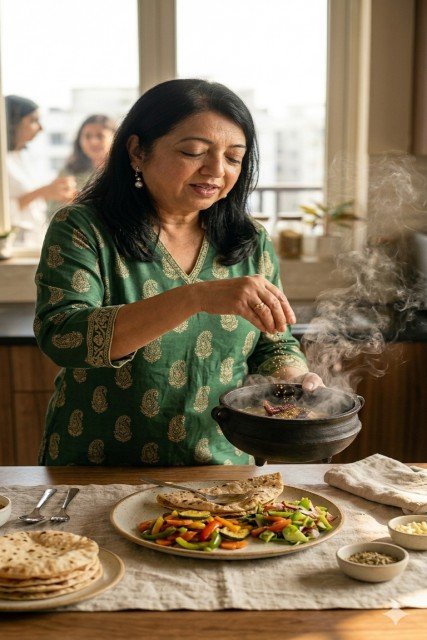
Heavy masalas have left my kitchen entirely. Lentils no longer have a place here. Himalayan pink salt has replaced ordinary table salt. At half past four, fruit arrives, pomegranate or kiwi alongside a cup of butterfly blue pea tea, which turns a shade of blue that still strikes me as quietly miraculous. Dinner comes early, at half past six, mirroring lunch in its simplicity. After eight o’clock, a square of dark chocolate and an oatmeal cookie honour the truth that pleasure is also nourishment. Chamomile tea closes the day with grace. Two or three times weekly, nettle leaf and horsetail tea do their quiet, cumulative work.
I occasionally laugh at myself. I have become a rather expensive eater. The grocery bill tells a story my younger self would not have anticipated. However, at this stage of life, investing in one’s own body is not an indulgence. It is simply the most overdue form of self-respect.
Cheat Days Are Sacred Too
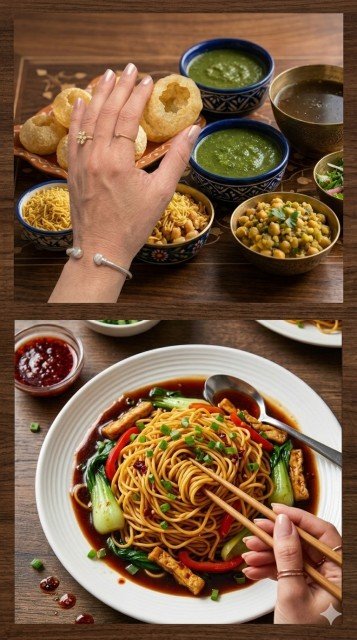
None of this means joy has been rationed. Indeed, cheat days are honoured with cheerful commitment. Chinese food remains a particular weakness, consumed with zero guilt and considerable enthusiasm. Panipuri calls loudly, and I answer, though I make it at home where I control every element. Zero-sugar desserts appear when the occasion demands. When I dine out, I choose deliberately rather than restrictively. That distinction matters enormously.
What Feeding Your Soul Really Means
Feeding your own soul is not confined to what arrives on your plate. Rather, it is the practice of returning, again and again, to what makes you feel most fully yourself, even after loss has attempted to convince you that those things are gone forever.
My kitchen gave back my voice when grief had rendered it silent. The diet gave back my vitality when age was quietly making its claims. My daughter’s gentle persistence gave back my creativity when sorrow had borrowed it without permission. And the Kobbari Maamidikaya of summer, the Munjalu, the monsoon bhutta, the winter peanuts: these gave back something harder to name. A rootedness. A continuity. The reassurance that life, in its seasonal rhythms, keeps offering you something worth savouring.
The main ingredient was never in the pantry. It was always the intention, in the willingness to begin again, to cook with love even on the days when love is the hardest thing to access, and to feed yourself, your actual self, with the same wholehearted generosity you have always extended to everyone else.
This post is part of Blogchatter’s A2Z Challenge.
The Theme of my A2Z series is The Second Half
Find all my A2Z Blogs Below




 @wordsmithkaur
 @wordsmithkaur